


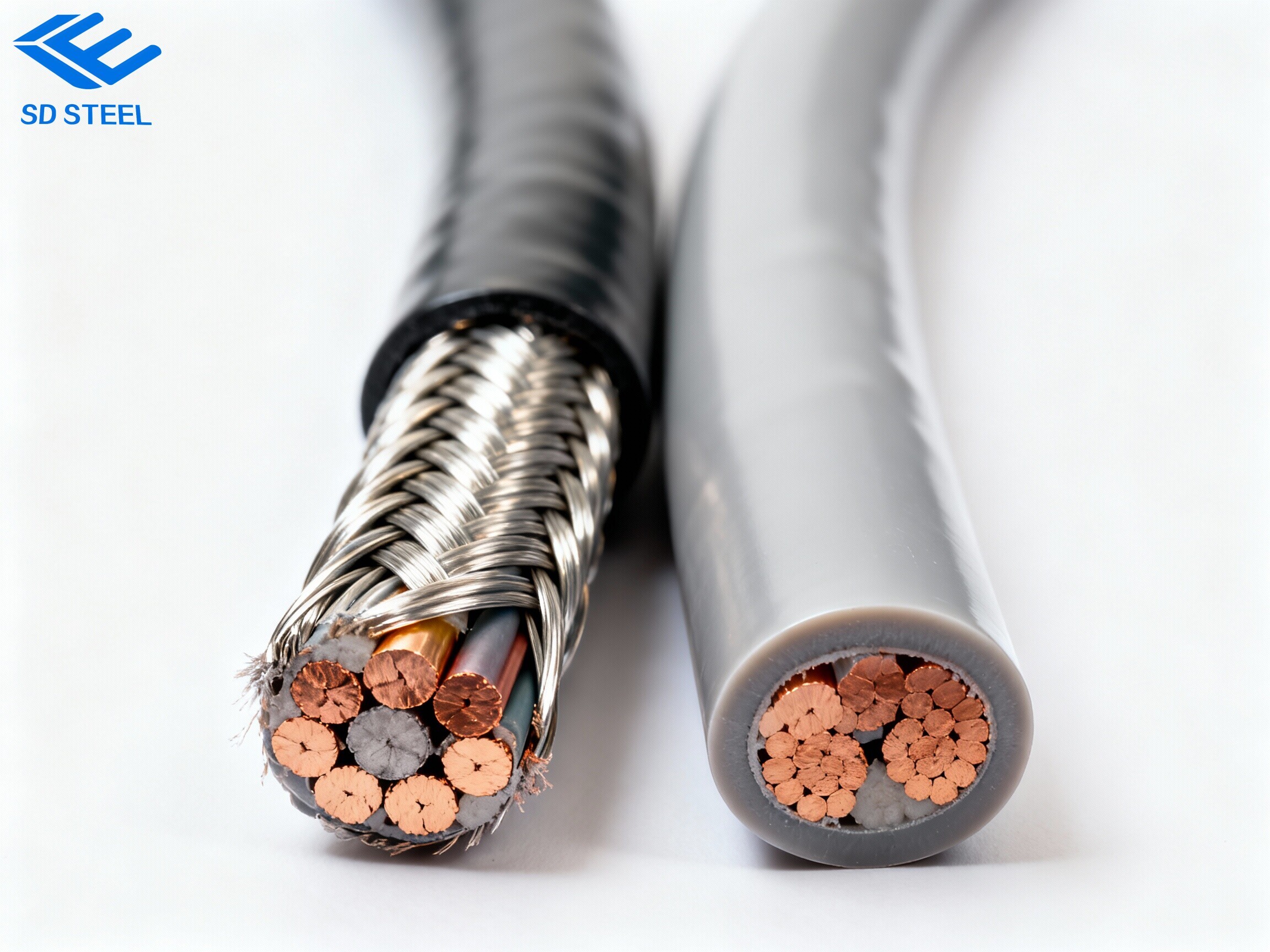
Structural Differences
Armored Wires: These wires have an added metal armor layer between the insulation layer and the outer sheath, typically made of steel tape or wire. This armor layer protects the wire from external mechanical damage, prevents rodent bites, and provides some shielding, reducing electromagnetic interference.
Unarmored Wires: These wires lack an armor layer and have a relatively simple structure, usually consisting of a conductor, insulation layer, and outer sheath. This structure makes unarmored wires more flexible and easier to bend and install.
Performance Differences
Mechanical Strength: Armored wires, due to their metallic armor layer, possess high mechanical strength and can withstand significant tensile, compressive, and impact forces. For example, in direct burial installations or environments susceptible to mechanical vibration, armored wires better protect the internal conductor and insulation layer. Unarmored wires have relatively lower mechanical strength and are suitable for environments with lower external impact risks.
Protective Performance: The armor layer of armored wires effectively prevents external objects from puncturing, squeezing, or damaging the wire. It also possesses a certain degree of water and moisture resistance, making it suitable for harsh environments. Unarmored wires primarily rely on their insulation layer and outer sheath for protection, offering relatively weaker protection and requiring more stringent installation environmental conditions.
Electromagnetic Shielding Performance: Armored wires possess excellent electromagnetic shielding performance due to their metallic armor layer. This reduces the interference of electromagnetic fields generated by internal currents on the external environment and prevents external electromagnetic fields from interfering with signal transmission within the wire. Unarmored wires typically lack a dedicated electromagnetic shielding structure, resulting in poorer electromagnetic shielding performance. In environments with severe electromagnetic interference, additional shielding measures may be necessary.
Classification Differences: Armored wires can be classified into three types: steel tape armored, fine steel wire armored, and coarse steel wire armored.
Unarmored wires can be classified into various types, including flame-retardant rubber-sheathed wires, power lines, communication lines, and optical fibers.
Different Application Scenarios:
Armored wires, due to their additional metallic protective layer, are suitable for underground installation, cable trench laying, or direct burial in environments where significant mechanical stress is expected. They are primarily used for temperature measurement, signal transmission, and special heating in industries such as chemical engineering, metallurgy, machinery manufacturing, power generation, and scientific experiments.
Unarmored wires are generally not used for underground installation but are widely used in various electrical equipment and circuits, such as televisions, electronic products, and optical fibers, for transmitting electrical energy and signals. In summary, armored and unarmored wires differ in structure, performance, classification, and application scenarios. Armored wires possess superior mechanical properties and corrosion resistance, making them widely used in complex environments and applications with special requirements for power and signal transmission. Using armored wires effectively protects them from external damage, extends their service life, and ensures the stability and reliability of power and signal transmission.
Latest News
- What are the five categories of wires and cables?
- Household Wiring Guide
- What Are Solar Panels? Types, Selection, and Buying Guide
- Power Transformers: How Do They Work and What Are Their Uses?
- How to Select the Appropriate Wire and Cable Model and Cross-Section
- What constitutes a box-type substation or a box-type transformer? What are box-type substations, and what are their applications?
Send Us A Message
Send Your Inquiry
We welcome your cooperation and we will develop with you.