


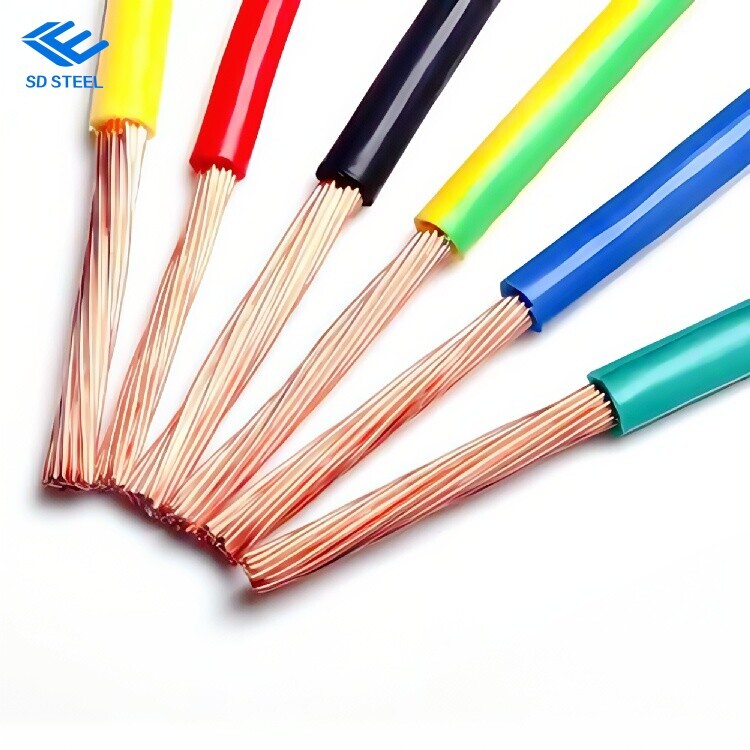
An electric wire consists of one or several stiff conductors covered by a soft sheath; a cable consists of one or several insulated conductors covered by a tough outer layer made of metal or rubber. Both electric wires and cables generally consist of three parts: the core wire, the insulation sheath, and the protective outer sheath. There is no strict distinction between "electric wire" and "cable."
Products with fewer cores, smaller diameters, and simpler structures are generally called wires; those without insulation are called bare wires; and others are called cables. Conductors with larger cross-sectional areas (greater than 6 square millimeters) are called large wires, and those with smaller cross-sectional areas (less than or equal to 6 square millimeters) are called small wires.
Cables generally have two or more layers of insulation, are mostly multi-core, and are wound on cable reels, with a length generally exceeding 100 meters. Wires, on the other hand, are generally single-insulated, single-core, and come in 100-meter rolls without reels.
Material Differences: Electric wires are conductive metal wires used to carry current. They come in various forms, including solid, stranded, and braided. Based on insulation, they are divided into two main categories: bare wires and insulated wires. Cables are insulated conductors consisting of one or more mutually insulated conductive cores enclosed in a sealed sheath. An additional protective covering layer may be added. The difference between electric wires and cables lies in the fact that electric wires are generally smaller and simpler in structure, although cables are sometimes included in the broader category of electric wires.
Differences in Application: Bare wires are wires without any insulation or protective layer. Besides being used as conductors for transmitting electrical energy and information, they can also be used to manufacture components and connecting wires for motors and electrical appliances. They are generally made of copper, aluminum, copper alloys, or aluminum alloys. In addition, there are various insulated wires suitable for special requirements, such as low-voltage automotive wires, high-voltage automotive ignition wires, motor and electrical appliance lead wires, aviation wires, and compensating wires. Cables are used to transmit and distribute electrical energy or transmit electrical signals. Cables can be classified according to their application into power cables, communication cables, and control cables, etc.
The main difference between power cables and ordinary wires lies in their larger size and more complex structure. Cables primarily consist of four parts: Conductive core: made of high-conductivity material; Insulation layer: the insulation material used in cables should have high insulation resistance and high breakdown electric field strength. Cables are often classified according to their insulation material. Besides the above differences, cables also have significant advantages. Compared to overhead lines, cables have smaller inter-line insulation distances, require less space, can be laid underground without occupying above-ground space, are unaffected by environmental pollution, have high power transmission reliability, and cause less interference to personal safety and the surrounding environment. Therefore, cables are widely used in densely populated areas, areas with dense power grids, and areas with heavy traffic. They play an indispensable role in modern construction.
Latest News
- What are the five categories of wires and cables?
- Household Wiring Guide
- What Are Solar Panels? Types, Selection, and Buying Guide
- Power Transformers: How Do They Work and What Are Their Uses?
- How to Select the Appropriate Wire and Cable Model and Cross-Section
- What constitutes a box-type substation or a box-type transformer? What are box-type substations, and what are their applications?
Send Us A Message
Send Your Inquiry
We welcome your cooperation and we will develop with you.