


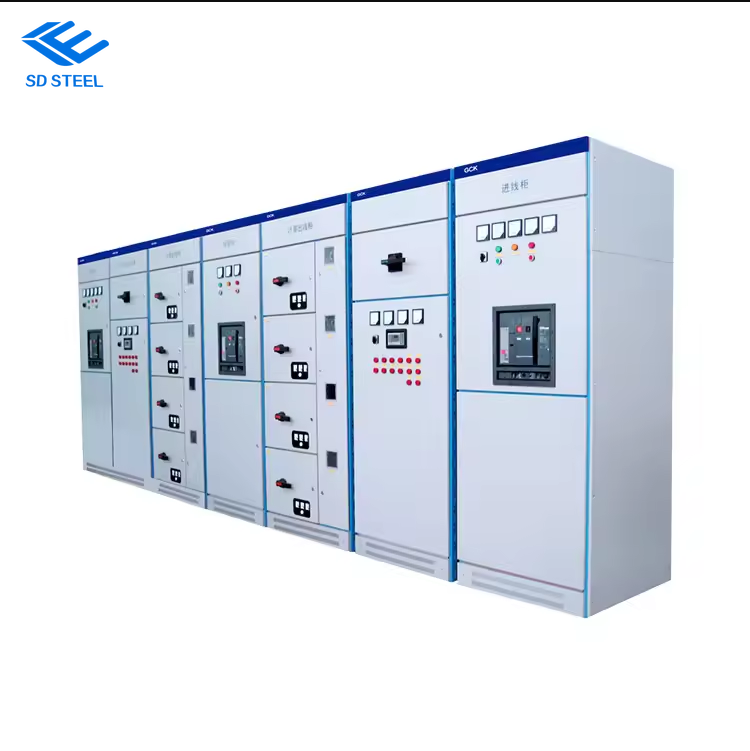
What Is a Box-Type Substation?
The box-type substation represents a new type of complete power distribution and transformation assembly that emerged following the era of traditional civil-construction substations. A box-type substation (often abbreviated as "box-sub") is a factory-prefabricated, compact power distribution unit—suitable for both indoor and outdoor use—in which high-voltage switching equipment, distribution transformers, and low-voltage distribution devices are integrated into a single entity according to a specific wiring scheme. It organically combines functions such as high-voltage power reception, voltage step-down via transformers, and low-voltage power distribution within a fully enclosed, portable steel enclosure. This enclosure is designed to be moisture-proof, rust-proof, dust-proof, rodent-proof, fire-resistant, theft-proof, and thermally insulated; it embodies a mechatronic design and operates as a fully enclosed system. Box-type substations are particularly well-suited for the construction and modernization of urban power grids, and they find wide application in mines, industrial facilities, oil and gas fields, and wind power stations. Depending on variations in structural design and the specific components utilized, box-type substations are typically categorized into two distinct styles: the European-style box-substation and the American-style box-substation.
Description and Applications of Pad-Mounted Transformers
The pad-mounted transformer is a fully sealed, reinforced steel enclosure structure. It integrates the design of traditional transformers into a compact, cabinet-style housing, offering advantages such as light weight, small footprint, low noise levels, low energy loss, and high reliability. It is currently widely utilized in residential communities, commercial centers, light rail stations, airports, industrial plants, corporate facilities, hospitals, schools, and similar locations.
As a complete distribution equipment assembly, the pad-mounted transformer has been extensively adopted in power engineering construction projects. It consists of an organic combination of a transformer, high-voltage control equipment, and low-voltage control equipment. Its fundamental operating principle involves the rational assembly—executed in a prescribed sequence—of pressure-activated systems, armored cabling, automated substation control systems, DC power points, and associated technical apparatus. All these components are then installed within a specific, fully sealed, and reinforced steel enclosure designed to be waterproof, dustproof, and rodent-proof, thereby constituting this specialized type of transformer unit.
Although compact in size, the pad-mounted transformer is far more than just a transformer; it functions essentially as a miniature substation—specifically a distribution station—that supplies power directly to end-users. The unit comprises three distinct compartments: a high-voltage compartment, a transformer compartment, and a low-voltage compartment. The high-voltage compartment serves as the power input side—typically accommodating incoming lines of 35 kV or 10 kV—and houses components such as high-voltage busbars, circuit breakers (or fuses), voltage transformers, and surge arresters. The transformer compartment contains the transformer itself, which constitutes the core component of the unit. The low-voltage compartment houses low-voltage busbars, low-voltage circuit breakers, metering devices, surge arresters, and similar equipment; power lines are routed outward from these low-voltage busbars to distribute electricity to the users.
Box-Type Substations and Their Applications
A "box-type substation" (also known as a compact substation) is a modern, complete set of power distribution equipment that emerged as a successor to traditional civil-construction substations. Generally, the term refers to a *prefabricated* substation; however, non-prefabricated versions also exist for situations involving specific constraints regarding size, transportation, or other factors that preclude pre-assembly.
A box-type substation is a self-contained unit in which key components—such as transformers, high-voltage switchgear, and low-voltage switchgear—are securely installed within a single enclosure (constructed from either metal or non-metallic materials). The entire unit is transported to the site as a single entity; once positioned at the designated location, the equipment becomes operational simply by connecting the necessary power cables. These units are particularly well-suited for the construction and modernization of urban power grids (specifically within 10/0.4 kV three-phase AC systems, where they serve to route and distribute electrical energy). For instance, in urban residential complexes or along city streets, box-type substations are deployed to boost voltage levels during peak demand periods. They are also utilized for providing temporary power supplies—such as at construction sites, port terminals, or airports—or for upgrading power distribution systems within existing structures.
Based on their structural design, box-type substations can be broadly categorized into two types: standard and compact. Standard models include types such as the ZBW and XWB, while compact models include types such as the ZB1-336 and GE-style substations. In 10 kV distribution configurations, box-type substations typically forgo the use of circuit breakers; instead, they commonly employ a combination of load break switches (such as the FN5-10 or FN7-10 models) paired with fuses, often integrated into a ring-network power supply arrangement. Power is typically supplied to the high-voltage side of the transformer via a branch connection tapped directly from an adjacent overhead power line. Furthermore, depending on the specific structural design and the components utilized, box-type substations are generally classified into two distinct stylistic categories: the "European-style" box-type substation and the "American-style" box-type substation.
Latest News
- What are the five categories of wires and cables?
- Household Wiring Guide
- What Are Solar Panels? Types, Selection, and Buying Guide
- Power Transformers: How Do They Work and What Are Their Uses?
- How to Select the Appropriate Wire and Cable Model and Cross-Section
- What constitutes a box-type substation or a box-type transformer? What are box-type substations, and what are their applications?
Send Us A Message
Send Your Inquiry
We welcome your cooperation and we will develop with you.