


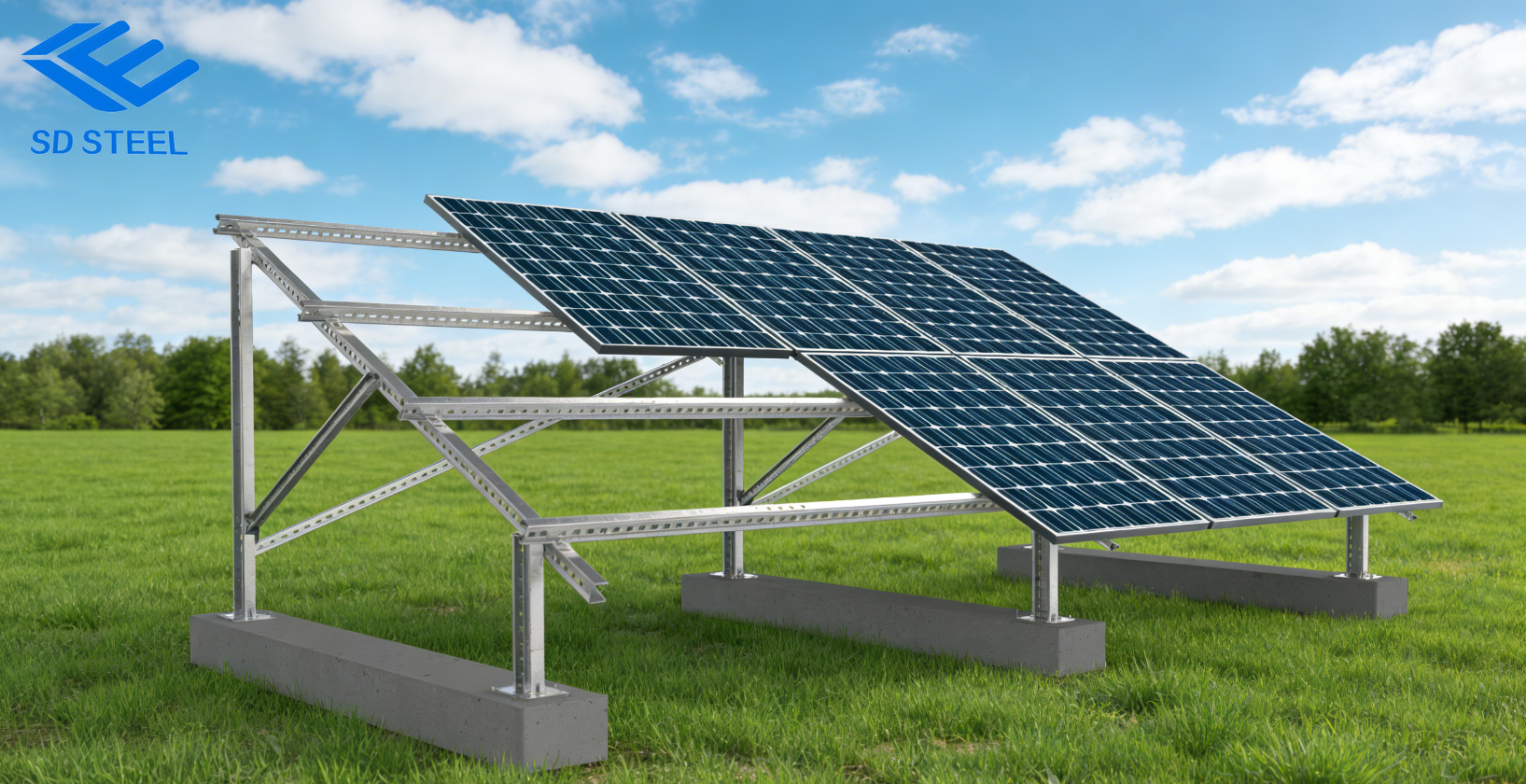
When selecting photovoltaic mounting structures, it is necessary to choose different materials based on different application conditions. Based on the materials used for the main load-bearing components of the photovoltaic mounting structure, they can be divided into aluminum alloy brackets, steel brackets, and non-metallic brackets (flexible brackets). Non-metallic brackets (flexible brackets) are less commonly used, while aluminum alloy and steel brackets each have their own characteristics.
Non-metallic support structures (flexible supports) utilize pre-stressed cable structures to overcome the technical challenges of installing traditional support structures in locations with limited spans and heights, such as wastewater treatment plants, complex mountainous terrain, low-load-bearing roofs, integrated solar and forestry projects, integrated solar and water projects, driving schools, and highway service areas. This effectively addresses the difficulties in construction, severe shading, and low power generation (approximately 10%-35% lower compared to photovoltaic power plants on flat terrain), as well as the poor quality and complex structure of existing support systems in mountainous and hilly areas.
In general, non-metallic supports (flexible supports) offer broad adaptability, flexibility in use, effective safety, and economic benefits through perfect secondary land utilization, making them a revolutionary innovation in photovoltaic support systems.
A well-designed photovoltaic mounting structure can improve the system's resistance to wind and snow loads. By effectively utilizing the load-bearing characteristics of the photovoltaic mounting system, its dimensions can be further optimized, saving materials and further reducing the cost of the photovoltaic system.
The main loads acting on the foundation of photovoltaic module support structures are: the self-weight of the support structure and photovoltaic modules (dead load), wind load, snow load, temperature load, and seismic load. Of these, the wind load is the controlling factor; therefore, the foundation design should ensure stability under wind load. Under wind load, the foundation may experience failure modes such as uplift and fracture. The foundation design should ensure that no such failures occur under this force.
So, what types of foundations are used for ground-mounted and flat-roof solar panel support structures? What are their characteristics?
Ground-mounted photovoltaic support structure foundation
Bored pile foundations: Hole formation is relatively easy, the foundation top elevation can be adjusted according to the terrain, and the top elevation is easy to control. They require less concrete and reinforcement steel, involve less excavation, allow for faster construction, and cause minimal damage to existing vegetation. However, they involve on-site hole formation and concrete pouring, and are suitable for general fill soil, cohesive soil, silt, and sandy soil.
Steel helical foundations: Easy to drill holes, the top surface elevation can be adjusted according to the terrain, unaffected by groundwater, construction can proceed normally under winter weather conditions, construction is fast, elevation adjustment is flexible, and there is minimal damage to the natural environment. There is no need for earthwork or excavation, and there is minimal damage to existing vegetation. Suitable for deserts, grasslands, tidal flats, deserts, and permafrost. However, it uses a large amount of steel and is not suitable for highly corrosive foundations or rock foundations.
Independent foundations: Strongest resistance to water loads, resistant to floods and wind. Requires the largest amount of reinforced concrete, requires more labor, involves large amounts of excavation and backfilling, has a long construction period, and causes significant environmental damage. It is rarely used in photovoltaic projects anymore.
Reinforced concrete strip foundations: This type of foundation is often used in areas with poor soil bearing capacity, relatively flat terrain, and low groundwater levels, and is suitable for single-axis tracking photovoltaic mounting systems that require high resistance to differential settlement.
Precast pile foundations: Prestressed concrete pipe piles with a diameter of approximately 300mm or square piles with a cross-section of approximately 200mm x 200mm are driven into the soil. Steel plates or bolts are left at the top for connection to the front and rear columns of the upper support structure. The depth is generally less than 3 meters, and construction is relatively simple and fast.
Flat Roof Photovoltaic Mounting Bracket Foundation
Concrete Ballast Method: Concrete blocks are poured onto the concrete roof. This is a common installation method, offering stability and not damaging the roof's waterproofing.
Precast Concrete Ballast: This method is relatively more time-efficient than pouring concrete blocks on-site and saves on the need for embedded concrete components.
Latest News
- What are the five categories of wires and cables?
- Household Wiring Guide
- What Are Solar Panels? Types, Selection, and Buying Guide
- Power Transformers: How Do They Work and What Are Their Uses?
- How to Select the Appropriate Wire and Cable Model and Cross-Section
- What constitutes a box-type substation or a box-type transformer? What are box-type substations, and what are their applications?
Send Us A Message
Send Your Inquiry
We welcome your cooperation and we will develop with you.