


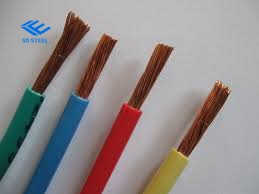
A: Traditional PVC wires and cables produce smoke containing toxic gases such as hydrogen halide, carbon monoxide, and carbon dioxide when burned. This not only hinders rescue efforts but also causes a "secondary disaster" to life and property;
B: The strongest opposition to the use of PVC comes from Switzerland, Germany, Sweden, the United States, Japan, and other countries. The legislative and regulatory bodies in these countries have enacted strict laws to restrict and ultimately eliminate the industrial use of PVC;
2. Characteristics of Low-Smoke Halogen-Free Wires:
(1) Higher tensile strength than general PVC wires: General PVC wires have a tensile strength greater than 1.05 Kgf/mm², while low-smoke halogen-free wires have a tensile strength greater than 1.2 Kgf/mm²;
(2) Good weather resistance (-30℃~105℃);
(3) Good flexibility (hardness of 80-90);
(4) Non-migratory (because no plasticizers are added to the product formula, there is no migration);
(5) Does not produce toxic black smoke when burning (produces a small amount of white smoke);
(6) Higher volume resistivity: PVC wires generally have a volume resistivity of 10¹²~10¹⁵ Ω/cm³, while low-smoke halogen-free wires have a volume resistivity greater than 10¹⁶ Ω/cm³;
(7) Good high-voltage resistance: PVC wires generally withstand 10KV or more, while low-smoke halogen-free wires withstand 15KV or more;
(8) Good elasticity and viscosity.
3. Additives for Low-Smoke, Halogen-Free Wire and Cable Formulations:
(1) Linear PE and elastic PE are selected as the main resins. The flame retardant materials used are three metal oxides containing crystal water, which lose their crystal water at 200℃, 300℃, and above 300℃, respectively. They are Non-6P, meaning they do not contain phthalates.
According to new EU regulations, DEHP (di(2-ethylhexyl) phthalate), DBP (dibutyl phthalate), and BBP (benzyl butyl phthalate) will be restricted in PVC materials used in all children's toys, clothing, and other articles; similarly, DINP (diisononyl phthalate), DIDP (diisodecyl phthalate), and DNOP (di-n-octyl phthalate) are also restricted in children's toys, clothing, and all articles that may be placed in the mouth; the content of these six components (6P) must not exceed 0.1%, and products exceeding 0.1% cannot be sold on the EU market.
Latest News
- What are the five categories of wires and cables?
- Household Wiring Guide
- What Are Solar Panels? Types, Selection, and Buying Guide
- Power Transformers: How Do They Work and What Are Their Uses?
- How to Select the Appropriate Wire and Cable Model and Cross-Section
- What constitutes a box-type substation or a box-type transformer? What are box-type substations, and what are their applications?
Send Us A Message
Send Your Inquiry
We welcome your cooperation and we will develop with you.