


News
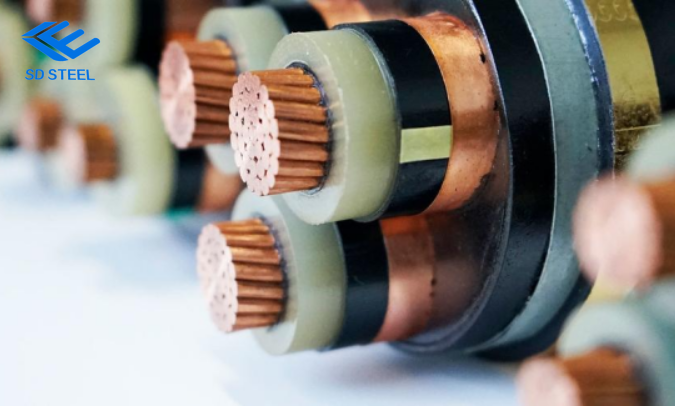
Key Features
Extremely high electrical insulation strength
Materials: Primarily cross-linked polyethylene is used, possessing excellent electrical properties, heat resistance, mechanical strength, and resistance to environmental stress cracking. Low-viscosity oil-filled cables (MI) or self-contained oil-filled cables (OF) are still used in a few special applications.
Purity and Uniformity: Extremely stringent requirements are placed on the purity, impurity content, and micropore control of the insulation materials. A highly clean production environment (cleanroom) is required to minimize partial discharge and ensure long-term stability under extremely high electric fields.
Inner and Outer Semiconductor Shielding Layers: Precise conductor shielding and insulation shielding (semi-conductive layers) are crucial for uniformizing the electric field on the conductor surface and the insulation surface, preventing corona discharge and accelerated insulation aging caused by localized electric field distortion.
Huge transmission capacity
Large conductor cross-sectional area (commonly 800mm², 1000mm², or even 2500mm²), employing a segmented conductor structure (such as the Milliken structure) to reduce skin effect and proximity effect, thereby lowering AC resistance.
Low Loss
Conductor Loss: Reduced by optimizing conductor structure and materials (high-purity copper or aluminum).
Dielectric Loss: XLPE insulation itself has a very low dielectric loss tangent. Oil-filled cables also have very low oil dielectric loss.
Metallic Sheath Loss: The grounding method of the metallic sheath (aluminum or lead) (single-point, cross-connection) must be considered during design to minimize losses caused by induced circulating currents.
Excellent mechanical properties
It can withstand the enormous mechanical stresses during manufacturing, transportation, and laying (especially traction and bending).
It possesses sufficient resistance to pressure, impact, and vibration.
A metal sheath (corrugated aluminum sheath, welded aluminum sheath) or a composite sheath provides radial waterproofing and mechanical protection.
Excellent Thermal Performance
High conductor operating temperature (XLPE typically 90°C, with short-term overload up to 130°C; oil-filled cables can reach 85-90°C).
Accurate current-carrying capacity calculations are required, taking into account factors such as laying method (air, direct burial, duct, tunnel), ambient temperature, soil thermal resistivity, and proximity effect.
Insulation materials must maintain stable performance under long-term high temperatures.
Long lifespan and high reliability
The design lifespan is typically 30-40 years or more.
The requirements for materials, manufacturing processes, quality control, and testing are extremely stringent (such as partial discharge testing, power frequency withstand voltage testing, and lightning impulse testing before shipment).
Main application areas
1. Urban Power Grid Core Transmission and Underground Transmission Upgrades
Urban Center Power Supply:Addressing land scarcity, aesthetic requirements, and electromagnetic environment limitations in city centers by introducing high-voltage power to load centers.
Overhead Line Undergrounding:Beautifying the urban environment, freeing up land resources, and improving power supply reliability (reducing common overhead line faults such as lightning strikes, windstorms, and pollution flashovers).
Underground Substations:Connecting urban underground substations to form a robust underground transmission network.
2. Power Transmission for Large Hydropower Stations, Nuclear Power Plants, and Thermal Power Plants
Crossing Rivers, Lakes, and Seas:When power plant transmission lines need to cross wide bodies of water (large rivers, bays, straits), ultra-high-voltage cables are the only or optimal choice (e.g., Three Gorges Dam transmission, Zhoushan Interconnection Project, Qiongzhou Strait Interconnection Project).
Crossing Complex Terrain: When the line route involves important ecological protection areas, densely populated residential areas, military restricted areas, or other areas unsuitable for tower erection.
3. Island Power Supply and Cross-Sea Power Grid Connection
Achieving power grid interconnection between the mainland and large islands (such as Hainan Island and the Zhoushan Islands) or between islands, ensuring reliable power supply and renewable energy consumption for islands.
4. Power Supply for Special Environments
High-altitude areas, heavily polluted areas, chemical industrial zones, etc.
Structural features
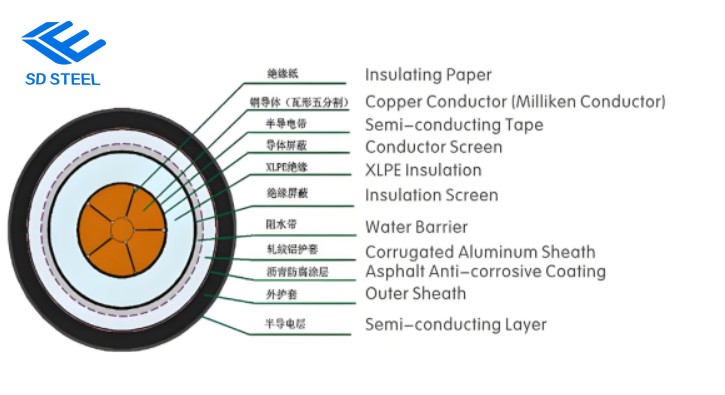
Conductor
Material: High-purity annealed copper or electrical aluminum (copper is more commonly used due to its higher conductivity but higher cost).
Structural Features: Large cross-sections are typically 800 mm², 1000 mm², 1600 mm², 2500 mm², etc., to meet the requirements of high current transmission.
Segmented Conductor Structure: The large cross-section conductor is divided into multiple mutually insulated sector/tile-shaped strands (4-6 segments are most common).
Compacting Process: The stranded conductors are compacted to reduce gaps, increase the fill factor, and enhance mechanical strength.
Conductor Shielding Layer
Material: Ultra-smooth, ultra-clean extruded semi-conductive cross-linked polyethylene material.
Key Function: Eliminates burrs and unevenness on the conductor surface, resulting in an extremely smooth and uniform electric field distribution at the conductor-insulation interface. This prevents localized electric field concentration (field distortion) that could lead to partial discharge, which is crucial for long-term insulation stability.
2. Insulation Layer
Material: Ultra-pure cross-linked polyethylene is the absolute mainstream material. In very rare special cases (such as ultra-long submarine cables), low-viscosity oil-filled cables (MI) or self-contained oil-filled cables (OF) may be used.
3.Structural Features and Requirements:
Large Thickness: Designed according to voltage level (e.g., 500kV XLPE insulation thickness can reach over 30mm).
Ultra-Cleanliness: Requirements for impurities, micropores, and moisture content must reach the ppb (parts per billion) level.、Ultra-Uniformity: Extremely strict thickness tolerance control (usually required <5%), with no air bubbles, impurities, or defects allowed internally.
Co-extrusion Process: The conductor shielding layer, insulation layer, and insulation shielding layer must be extruded simultaneously to ensure absolutely smooth, gap-free, and contamination-free interlayer interfaces, forming a "three-layer co-extrusion integrated" structure. This is the core process to prevent partial discharge at the interface.
4.Insulating Shielding Layer
Location: Closely attached to the outer layer of the insulating layer.
Material: Also made of ultra-smooth, ultra-clean extruded semi-conductive cross-linked polyethylene material.
Key Functions: Uniform electric field, tight bonding with the insulating layer, and peelability.
5.Water-blocking buffer layer
Location: Outside the insulating shielding layer, inside the metal sheath.
Material: Usually a wrapped semi-conductive resistive water tape or an extruded semi-conductive resistive water buffer layer.
Key functions: Buffering, longitudinal water blocking, semi-conductive properties.
6. Outer Sheath
Material: Black high-density polyethylene (HDPE) or flame-retardant polyvinyl chloride (PVC-ST8).
Function: Mechanical protection, corrosion prevention, and flame retardancy.
Latest News
- What are the five categories of wires and cables?
- Household Wiring Guide
- What Are Solar Panels? Types, Selection, and Buying Guide
- Power Transformers: How Do They Work and What Are Their Uses?
- How to Select the Appropriate Wire and Cable Model and Cross-Section
- What constitutes a box-type substation or a box-type transformer? What are box-type substations, and what are their applications?
Send Us A Message
Send Your Inquiry
We welcome your cooperation and we will develop with you.