


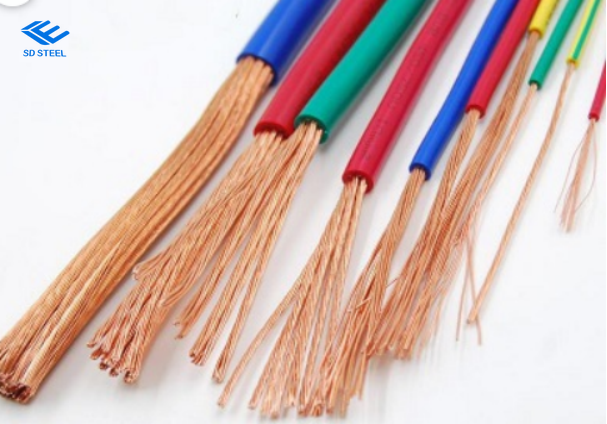
Typically, a conductor consisting solely of an insulating layer is referred to as a "wire," whereas one possessing not only an insulating layer but also a protective sheath is termed a "cable."
Common wire and cable models include: BV, BLV, BVR, RV, RVV, RVVP, RVS, and others.
For home renovation wiring, either BV or BVR cables are suitable options. BV cable is relatively rigid, but its overload capacity and weather resistance are significantly superior to those of BVR. In comparison to BV, BVR is more flexible, possesses a higher current-carrying capacity, and facilitates easier installation; however, it is also slightly more expensive.
Since BV wire is a single-strand conductor, compared to BVR wire—which shares the same cross-sectional area—its copper strands are thicker; consequently, it is less prone to burning out when subjected to prolonged high temperatures. Conversely, the copper strands in BVR wire are relatively fine, making it easier for one or two individual strands to burn out when temperatures rise. If even a single copper strand within the wire burns out, the effective cross-sectional area is reduced, resulting in increased electrical resistance and rendering the wire more susceptible to complete burnout.
In practical applications, because BVR wire is relatively soft, its connections tend to loosen over time; BV wire, by contrast, performs much better. Consequently, in home wiring projects, a "tinning" process is routinely employed to prevent connections from coming loose.
In factory power distribution systems, VV and YJV cables are the most commonly used types. Of these, VV cables are suitable only for environments at normal ambient temperatures, whereas YJV cables can be utilized in workshops with higher temperatures, capable of withstanding heat up to 90°C.
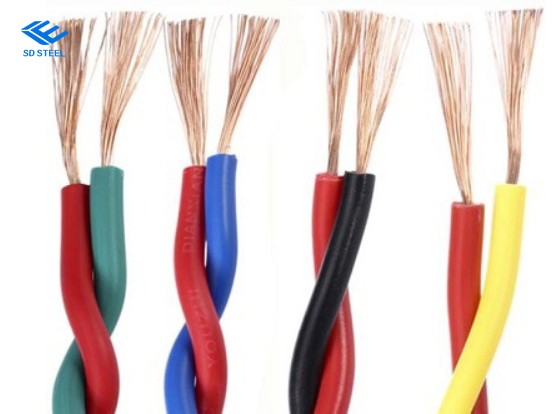
For control cabling, RVV cables are typically selected; however, if the surrounding environment contains strong magnetic or electric fields, a shielded cable—specifically the RVVP type—should be used instead. For fire alarm systems, twisted-pair cables (RVS) are generally preferred; in our region, these twisted-pair cables are also commonly referred to as "patterned wire."
Based on their materials, wires and cables are classified into the copper-core BV series and the aluminum-core BIV series; common cross-sectional areas range from 1.5 mm² to 120 mm².
The cross-sectional area of wires and cables is selected based on the calculated rated current derived from the electrical load. Taking a household setting as an example, the appliances utilized consist of both inductive and resistive loads; therefore, the rated current is calculated using the formulas P = UI and P = UIcosΦ.
Assuming the total power consumption of the household appliances is 10 kW, the calculated current *I* amounts to 56 A. As is well known, it is highly unlikely that all household appliances will operate simultaneously; consequently, a "simultaneity factor" (or diversity factor) ranging from 0.6 to 0.8 must be applied. By adopting a factor of 0.8, the adjusted current is calculated to be 45 A. Therefore, a 6 mm² copper-core wire or cable—specifically from the BV series—is suitable for use as the main power supply line for the household.
Latest News
- How to Select the Appropriate Wire and Cable Model and Cross-Section
- What constitutes a box-type substation or a box-type transformer? What are box-type substations, and what are their applications?
- transformer
- Applications and Description of Perforated Cable Trays
- Common Types of PV Mounting Structures and an Introduction to Mounting Foundations
- What are some key facts about low-voltage cables?
Send Us A Message
Send Your Inquiry
We welcome your cooperation and we will develop with you.